Case study · Pl. 02 of 03
Quilix
Saas Portfolio Builder
- Stack
- Python, Django, Django REST Framework, MySQL, React, AWS EC2, Git
- Chapters
- 01 Problem 02 Solution 03 Outcome
In short — Performance Metrics: Achieved and maintained a ~90 Lighthouse score across performance, accessibility, and SEO, giving users an immediate technical advantage over competitors using standard drag-and-drop builders. Seamless User …
The problem
For software engineers, designers, and freelancers, building and maintaining a personal portfolio is often a time-consuming distraction from their actual work. Many either settle for bloated, generic website builders that suffer from poor performance and bad SEO, or they spend countless hours building a custom site from scratch.
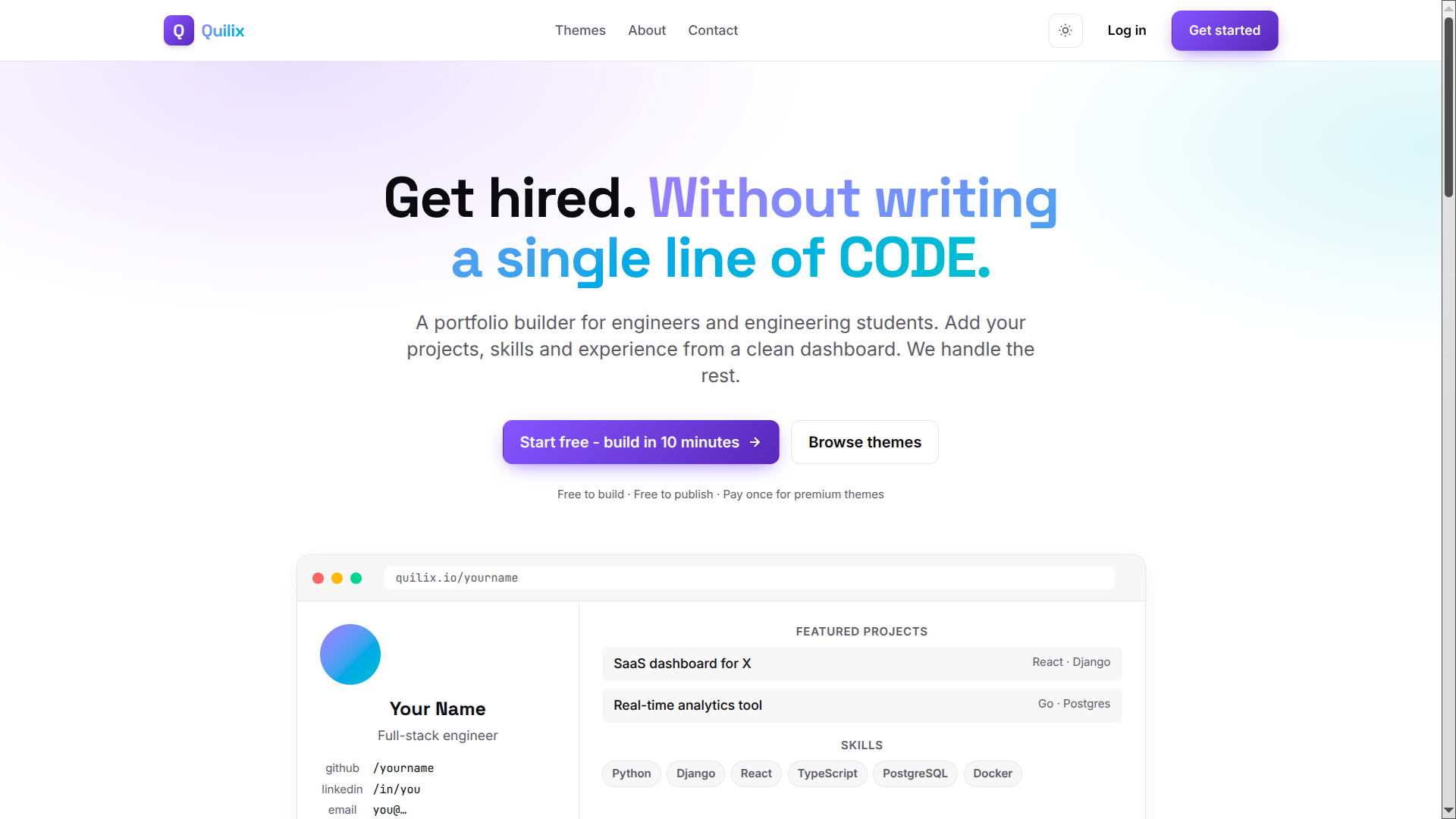
Quilix was built to solve this friction. It provides a dedicated multi-tenant SaaS platform where professionals can instantly generate highly performant, SEO-optimized portfolios hosted at a clean /username directory. It removes the technical overhead of building a site, allowing users to focus entirely on their content while guaranteeing a premium, lightning-fast end product.
The solution
To ensure high performance, security, and scalability, I architected Quilix using a decoupled, headless approach.
Stack: Python, Django, Django REST Framework (DRF), OpenAPI, and a Server-Side Rendered (SSR) frontend.
Architecture & Data Layer: The backend was built with Django and DRF, designed to serve a dual purpose. It exposes a heavily secured, token-authenticated write API for the user dashboard (handling data entry and theme configuration), and a lightning-fast public read API to serve portfolio data to the frontend. All endpoints were strictly documented using OpenAPI for seamless frontend integration and future scalability.
Routing & Multi-tenancy: I implemented a robust multi-tenant architecture that dynamically resolves user data based on the /username URL path, ensuring clean, easily shareable links without requiring custom domain configurations for MVP.
Theme Engine: I engineered a custom theme system supporting 5 unique templates (both free and premium). A key architectural decision was abstracting the data layer from the presentation layer, allowing users to execute one-click theme switches without losing or restructuring any of their underlying portfolio data.
Performance & SEO Strategy: Instead of a standard SPA (Single Page Application), I opted for Server-Side Rendering (SSR). This decision was critical for SEO, ensuring web crawlers could easily index user portfolios. I enforced strict semantic HTML and mobile-first responsive layouts across all 5 themes.
The outcome
Performance Metrics: Achieved and maintained a ~90 Lighthouse score across performance, accessibility, and SEO, giving users an immediate technical advantage over competitors using standard drag-and-drop builders.
Seamless User Experience: Reduced the time required to deploy a professional, responsive portfolio from days down to a few minutes, thanks to the intuitive API and one-click theme switching.
Business Viability: Successfully laid the groundwork for a scalable SaaS monetization model by splitting the template ecosystem into free and premium tiers, backed by a production-ready backend architecture.